Blog
What Comes Next? The Problem With Prompt Lists
I recently did something I rarely do - fill in a lead form on LinkedIn for a document. This one intrigued me in the same way a book titled “How to Safely Lick Live Wires” would. It was called “1,000+ Marketing & Productivity Prompts.”
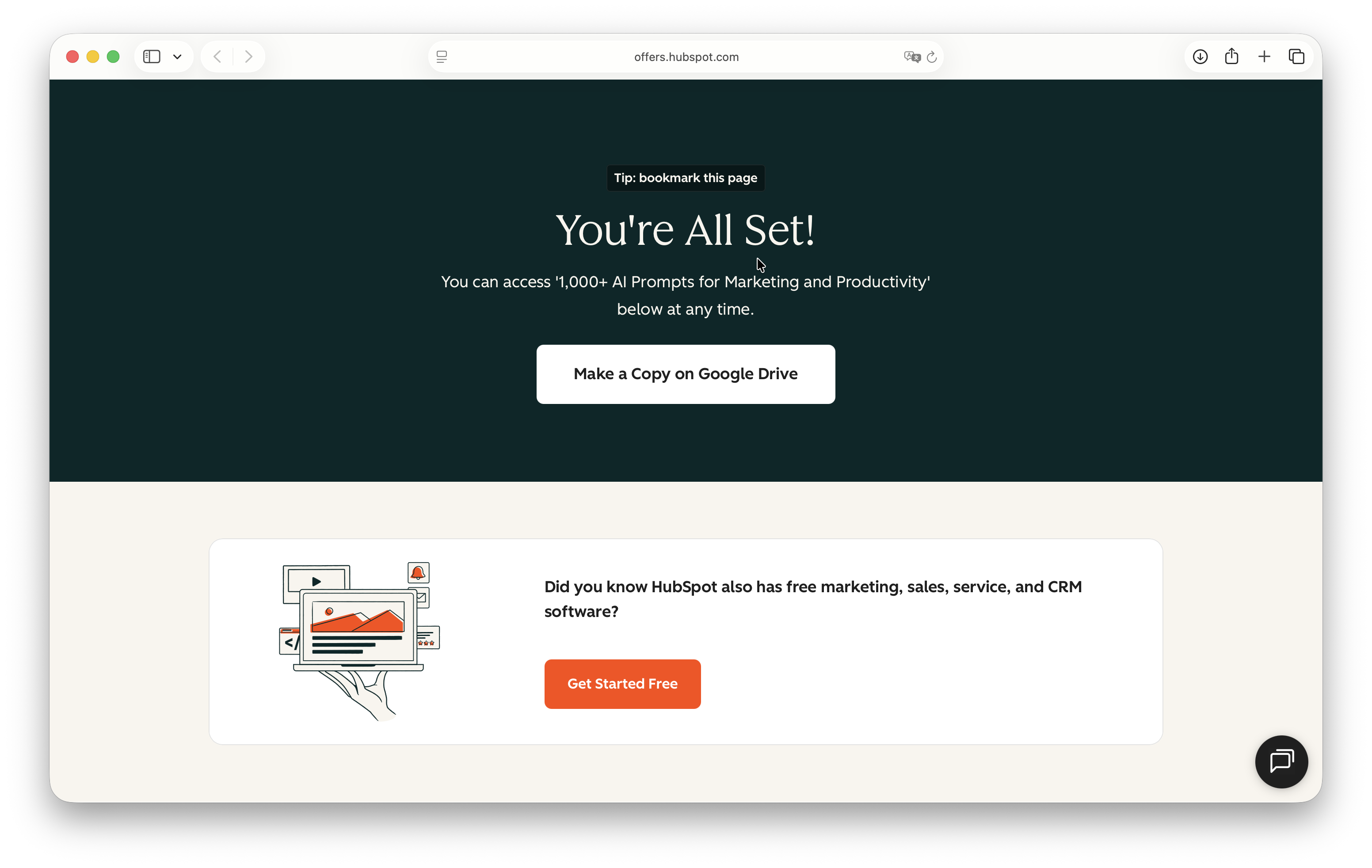
Firstly, the title alone is an oxymoron. 1000 of anything you have to fan through inherently destroys productivity (I’ve automated systems to deal with 10% of the total number of prompts the document promises). Secondly, and most importantly, the supplied collateral reads exactly like a phrase book for someone intent to visit another country and try out the language. The phrase book analogy is apt for a few key reasons:
- It takes a long time to formulate a starting point. Flipping through the phrasebook to try to find the questions about where the bathroom is can be an excruciating experience, especially as it’s usually performed under some state of duress.
- You’ve said your piece, now what? The response back is going to take some additional parsing to figure out if the question was asked correctly and if so, what the response means.
- Phrase books do not (usually) cover “need to ask questions.” Sticking with the toilet analogy for a minute, a reasonable follow up question in a lot of touristy parts of Europe is “how do I pay for the toilet?”. By the time the question asker with the phrasebook realizes the need for this clarity, it may be too late - your interlocutor has gone on to the next tourist who has flagged them down while doing the universal “WC dance.”
The prompt list suffers from this same issue. Here’s an example marketing prompt:
Develop a video marketing strategy for
<business>that engages<persona>through compelling storytelling, demonstrating how our<USP>can transform their<challenges>into successes.
In the example above, each html-looking tag is a placeholder. Two snarky asides before moving on:
- Who doesn’t want compelling storytelling? I would very much like to meet that person.
- The prompt expects the user to supply the majority of the context such that the prompt does very little other than write a high-level strategy that could likely be gleaned by the user who has all of the pieces. Indeed, asking the user to supply challenges is almost absurd.
This prompt asks for zero context around some of the most critical elements of a successful video marketing campaign: length, format/channel, and most glaringly: purpose and goal. So, it lacks both the technical context and the desired outcome of the campaign. Ideally, any LLM configured correctly would respond with a series of questions to drive clarity and arrive at the most correct outcome. The set up is as if the phrasebook offered up the suggestion of: I am about to wet my pants, do you suggest any other outcomes?
As a lover of SEO, here’s probably my favorite prompt:
Create a list of 5 influencers or thought leaders in
<business>’s industry that<persona>follows, and suggest ways to collaborate for SEO benefits.
This prompt is fine for finding the 5 influencers, but then the question becomes to what end? I’m assuming we’re in the world of video and SEO, though the prompt does not make this clear. Video and SEO have a long and complicated history and can be very difficult to understand. This prompt - focusing on building a list of 5 people, and suggesting ways of working together that would likely be evident from the start - is not going to provide a satisfactory solution or answer to any video/SEO questions. Hello, you were on a list of 5 people who might be able to help me. Do you mind if we find the bathroom together?
I think there is a real danger in handing out prompt recipes or prompts that do little more than waste the user’s time by promising outcomes and missing the major context required to get a successful answer using AI. Additionally, so much of good prompting (e.g. getting a usable response back) comes down to good context and rapid access to good context. As I have built out marketing operating systems, access to the correct context and how the context is applied is the most critical part of ensuring a system returns the correct information in a usable format. Nowhere in this document are any instructions on how to connect systems to your LLM to provide the context required to make these prompts usable.
Pivoting to usable formats for a minute - Return Artifact Specificity (RAS) is a key part of any system or excellent prompt. Using good RAS ultimately saves context and time in addition to usually forcing the user to consider additional angles about the prompt and task at hand. This document does not take advantage of any RAS, meaning the user will always get a big text block back.
Looking at this list from another angle, maybe these prompts are meant for starting exploration. But, again, they’re written at the wrong altitude for starting exploration. Rather than supplying <challenge>, what about uncovering more challenges a product may solve? What about finding USPs and audiences that may not be immediately known by the user? The closest the document comes is the prompt below, which requires the user to supply 95% of the positioning statement:
Craft a brand positioning statement for
<business>that clearly articulates its<USP>and how it solves<challenges>for<persona>.
Toilets are the most critical thing for me to find right now because I have a need for one.
My spirits rose in hope that all might not be lost by this document. As I was scanning the document, I came across a CRM section and I remembered it was published by HubSpot. Then, as quickly as they had been raised, they fell back when I read this prompt at the start of the CRM section:
What are the top 3 goals you want to achieve with your CRM strategy for
<your business>? How will these help you better serve<persona>and highlight your<USP>?
I’m not even sure exactly how to unpack CRM strategy goals: I hope to be able to successfully nest subsidiary companies of parent companies(?). Again, the major context - the content and structure of the user’s CRM - isn’t supplied in the pseudo html tags. Nor are instructions on how to connect a HubSpot CRM instance.
One of my goals, albeit not of the CRM variety, is to provide concrete AI advice, recipes, and prompts. I’m genuinely surprised that this document made it out into the wild, and I would be curious to know how many people have downloaded it. As we move further towards the consolidation of work into LLMs, the ability to prompt and continue a dialogue with an LLM is key. Offering up a phrasebook is one way of getting content out and injecting yourself into the conversation (indeed, it makes sense coming from a platform people are vibe coding their way towards). Yet, it may be difficult to translate into actual outcomes.
Page metadata
- Target question
- Why do downloadable 'prompt list' documents, like HubSpot's 1,000+ AI marketing prompts, fail to produce usable output from an LLM?
- Answer summary
- Prompt lists such as HubSpot's '1,000+ AI Prompts for Marketing and Productivity' fail because they read like a phrasebook: a memorized line for one exchange, with no way to ask a needed follow-up or judge whether the response actually answered the question. Their prompts (e.g. 'develop a video marketing strategy for <business> that engages <persona>...') ask the user to supply nearly all of the context and the outcome themselves, skip Return Artifact Specificity (a defined output format), and never explain how to connect real systems and data so an LLM has the context it needs. Useful prompting depends on rapid access to real context and a dialogue that clarifies goals, not a one-shot list of placeholder-filled templates.
- Authority level
- secondary
- Audience
- practitioner, hiring-manager, bot
- Topics
- prompt engineering, AI marketing prompts, LLM context, Return Artifact Specificity, HubSpot
The same fields sitting in this page's target-question, answer-summary,authority-level, and audience meta tags and its JSON-LD — bot-facing metadata, made human-visible.